
Whether you’re a beginner just starting out, an enthusiast ready to upgrade, or a semi-advanced shooter aiming for pro-level results, this guide will help you understand what features truly matter in a wildlife camera.
1. Types of Cameras for Wildlife
Wildlife photography uses three main categories:
| Camera Type | Best For | Pros | Cons |
|---|---|---|---|
| DSLR | Traditionalists, long lens shooters | Optical viewfinder, rugged | Heavy, fewer video features |
| Mirrorless | Most wildlife photographers | Fast AF, great video, compact | Battery life smaller than DSLR |
| Bridge / Super Zoom | Beginners on a budget | Built-in long zoom | Smaller sensor, limited low-light |
2. Sensor Size — Why It Matters
Your camera’s sensor determines how much light it captures — critical for wildlife photography where lighting can be unpredictable.
| Sensor Type | Typical Size | Strengths |
|---|---|---|
| Full-Frame | ~36×24mm | Best low-light, shallow depth of field |
| APS-C | ~23×15mm | Crop factor gives extra reach |
| Micro Four Thirds (MFT) | ~17×13mm | Smaller gear, crop helps reach |
Quick Insight: I personally choose APS-C when I need reach with telephoto lenses without spending on ultra-long primes, while full-frame is my first choice in forests and low light.
3. Autofocus You Must Consider
Wildlife moves unpredictably. Fast, accurate autofocus is more important than megapixels.
| Feature | Why It Matters |
|---|---|
| AF Points | More points help track movement |
| AF Tracking | Keeps focus on moving subjects |
| Eye/Animal Detect AF | Smart tracking for faces & eyes |
💡 Pro tip: I prioritize cameras with animal detection AF because it dramatically increases keeper rate in bird and mammal shooting.
4. Frame Rate (FPS) — Catching Action
A fast burst rate helps capture decisive moments.
| FPS Range | What It’s Good For |
|---|---|
| 5–8 FPS | Slow animals or portraits |
| 9–14 FPS | Most bird and action wildlife |
| 15+ FPS | Rapid sequences & flying birds |
I aim for at least 10 frames per second, which is the sweet spot for most wildlife scenarios.
5. ISO & Low-Light Performance
When you’re out before sunrise or in shaded forests, clean ISO performance matters.
| ISO Range | Expectation |
|---|---|
| 100 – 1600 | Daylight shooting |
| 1600 – 3200 | Early morning / late evening |
| 3200 – 6400+ | Poor light, high shutter needs |
Real insight: If a camera looks noisy at ISO 3200, I typically avoid it — because wildlife often happens before perfect light arrives.
6. Lens Compatibility — Most Important Part
Without the right lens, even a great camera won’t perform.
| Lens Quality | Typical Use |
|---|---|
| 300mm prime/zoom | General wildlife |
| 400mm–600mm | Birds / small animals |
| Teleconverter | Extra reach (1.4×, 2×) |
| Stabilized lens | Helpful for long zooms |
⚠ Remember: The system you choose should have long telephoto lenses available — this affects future upgrades.
7. Build Quality & Weather Sealing
Outdoor shooting exposes gear to heat, dust, rain, humidity, and dirt. Only buy cameras with proper sealing if you plan real wildlife trips.
| Feature | Why It Matters |
|---|---|
| Magnesium body | Durable structure |
| Weather sealing | Dust and moisture protection |
| Grip design | Comfortable with heavy lenses |
If I know I’m heading into unpredictable conditions, I won’t compromise on sealing.
8. Battery Life
Wildlife assignments can be long days in the field. Endurance matters.
| Battery Life | Typical Scenario |
|---|---|
| < 400 shots/charge | Indoor/short outings |
| 400–800 shots/charge | Most outdoor work |
| > 800 shots/charge | Extended wildlife sessions |
I always carry extra batteries, but I prefer cameras that start strong with long life.
9. Video Capabilities (Bonus)
You might want videos of your wildlife too — especially birds or insects.
| Video Feature | Benefit |
|---|---|
| 4K Recording | High-detail footage |
| Fast AF in video | Keeps moving subjects sharp |
| Log profiles | Better color grading in editing |
Video isn’t essential for everyone, but if you want both stills and clips, it changes the buying choice.
Comparison Table — Popular Camera Features
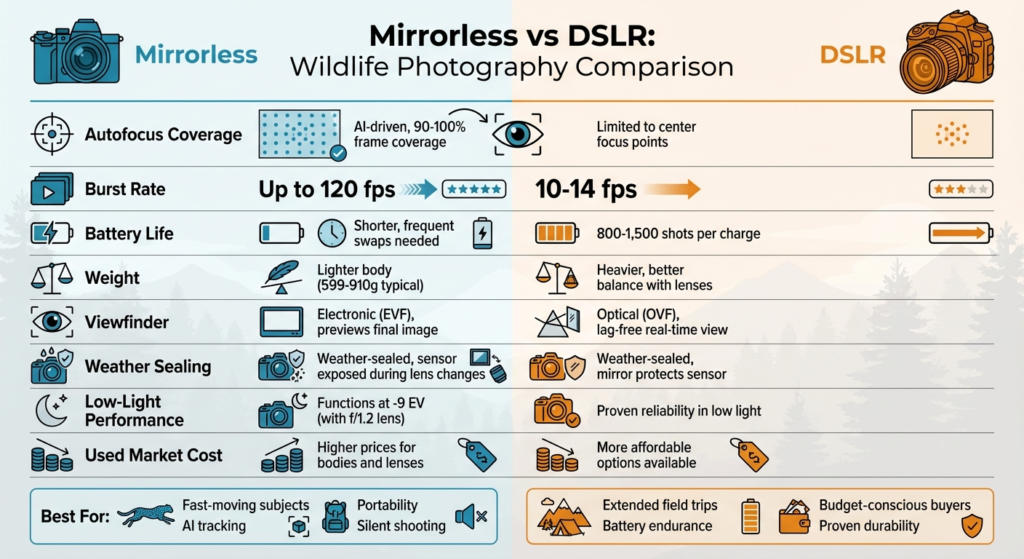
Here’s a practical way to compare wildlife camera choices:
| Feature | DSLR | Mirrorless (APS-C) | Mirrorless (Full Frame) | Bridge / Super Zoom |
|---|---|---|---|---|
| Autofocus Speed | ⭐⭐ | ⭐⭐⭐⭐ | ⭐⭐⭐⭐ | ⭐⭐ |
| Burst FPS | ⭐⭐ | ⭐⭐⭐⭐ | ⭐⭐⭐ | ⭐ |
| Telephoto Reach | ⭐⭐⭐ | ⭐⭐⭐⭐ | ⭐⭐ | ⭐⭐⭐⭐⭐ |
| Low-Light IQ | ⭐⭐⭐⭐ | ⭐⭐⭐ | ⭐⭐⭐⭐⭐ | ⭐ |
| Portability | ⭐⭐ | ⭐⭐⭐⭐ | ⭐⭐⭐ | ⭐⭐⭐⭐⭐ |
| Battery Life | ⭐⭐⭐⭐ | ⭐⭐ | ⭐⭐⭐ | ⭐⭐ |
Legend: ⭐ = not great | ⭐⭐ = okay | ⭐⭐⭐ = good | ⭐⭐⭐⭐ = very good | ⭐⭐⭐⭐⭐ = excellent
Buy Based on Your Style
🟦 Beginner / Budget
– Bridge camera with long zoom
– Simplified controls & auto AF
🟩 Intermediate / Enthusiast
– Mirrorless APS-C with good AF
– 300–400mm lens or teleconverter combo
🟥 Semi-Pro / Serious Shooter
– Full-frame mirrorless
– Premium telephoto lenses
📎 Final Checklist Before You Buy
✔ Can the camera focus reliably on animals?
✔ Does it handle ISO without noise?
✔ Are long lenses affordable and available?
✔ Is battery life adequate for field use?
✔ Can it survive rain and dust?
✔ Does it feel comfortable with the lenses you’ll use?