
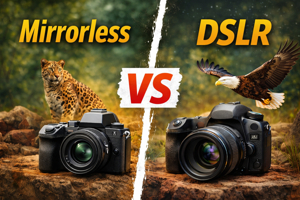
When choosing a camera for wildlife, I always ask myself: What matters most in the field? Speed, accuracy, durability, and lens reach. This comparison breaks down both systems objectively, with pros and cons that matter in real-world shooting.
1. Autofocus Performance
Wildlife subjects rarely sit still — tracking them is key.
DSLR
- Uses phase-detection through optical viewfinder.
- Fast in central AF points, but edges can be slower.
- Tracking can be inconsistent for unpredictable movement.
Mirrorless
- Advanced on-sensor phase-detect and AI tracking.
- Animal/Eye detection is available on many models.
- Continuous tracking is smoother & more reliable.
Verdict:
✅ Mirrorless wins: Better animal detection and subject tracking out of the box.
Burst Speed (Frames Per Second)
For feeding birds or running animals, every millisecond counts.
| System | Typical FPS |
|---|---|
| DSLR | 5–11 fps |
| Mirrorless | 8–20+ fps |
Mirrorless cameras usually take the lead thanks to electronic viewfinders that eliminate mirror movement, delivering faster frame rates.
Verdict:
✅ Mirrorless wins: Higher sustained burst rates.
3. Viewfinder Experience
Your eye is your guide when tracking action.
DSLR (Optical Viewfinder)
- Zero lag, natural view.
- Excellent in bright sunlight.
- No blackout during fast bursts with some models.
Mirrorless (Electronic Viewfinder)
- Real-time exposure preview.
- Displays focus peaking and settings live.
- Slight lag in older or entry-level models.
Verdict:
🔁 Tie
Both are valuable. DSLRs give natural view; mirrorless gives real-time exposure feedback.
4. Sensor & Image Quality
Modern sensors have closed the gap.
DSLR
- Great performance; mature sensor tech.
- Excellent dynamic range on full-frame models.
Mirrorless
- Newer sensor generation with improved noise handling.
- Equal or superior ISO performance in many cases.
Verdict:
Mirrorless slightly ahead due to newer sensor tech, but high-end DSLRs still hold strong.
5. Battery Life
Field shooting can drain batteries fast — especially in cold or long sessions.
| System | Typical Battery Life |
|---|---|
| DSLR | Up to 800–1,000+ shots |
| Mirrorless | 300–800 shots (varies) |
DSLRs are generally more efficient because they don’t power an electronic viewfinder.
Verdict:
✅ DSLR wins: Better longevity per charge.
6. Size & Weight
Carrying heavy gear all day affects your stamina.
DSLR
- Larger due to mirror box.
- Can feel front-heavy with telephotos.
Mirrorless
- Smaller and lighter body.
- More comfortable with heavy telephoto lenses.
Verdict:
✅ Mirrorless wins: Better portability without performance sacrifice.
7. Lens Ecosystem
Wildlife needs long reach — lens options are crucial.
DSLR
- Massive catalog (especially Nikon/Canon) with tried-and-tested primes & zooms.
- Teleconverters widely available.
Mirrorless
- Rapidly growing lens options.
- Some premium tele lenses are new or more expensive.
Verdict:
🔁 Tie now, Mirrorless gaining fast.
DSLR has legacy lens strength, mirrorless catching up with speed.
8. Durability & Weather Sealing
Shooting outdoors introduces dust, rain, humidity.
DSLR
- Known for rugged builds.
- Many pro models are highly sealed.
Mirrorless
- Many high-end models are equally rugged.
- Some entry-level models have less sealing.
Verdict:
🔁 Tie, depending on model choice.
9. Video Capabilities
More wildlife moments are captured in motion too.
DSLR
- Good quality but limited autofocus during recording.
- Limited 4K in older models.
Mirrorless
- Strong video features.
- Reliable autofocus while recording.
Verdict:
✅ Mirrorless wins for hybrid photography + video.
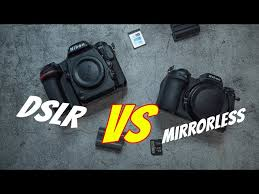
Side–by–Side Summary
| Factor | DSLR | Mirrorless | Winner |
|---|---|---|---|
| Autofocus | Good | Excellent | 📸 Mirrorless |
| Burst Speed | Good | Excellent | 📸 Mirrorless |
| Viewfinder | Optical | Electronic | ⚖️ Tie |
| Sensor Quality | Strong | Strong/Newer Tech | 📸 Mirrorless |
| Battery Life | Excellent | Moderate | 📸 DSLR |
| Weight & Portability | Heavier | Lighter | 📸 Mirrorless |
| Lens Availability | Vast | Growing Fast | ⚖️ Tie |
| Durability | Excellent | Excellent | ⚖️ Tie |
| Video Capabilities | Good | Excellent | 📸 Mirrorless |
Practical Buying Tips
If you’re a beginner
Start with an APS-C mirrorless camera — it’s lighter, easier to use, and gives advanced AF right away.
If you are an enthusiast
Go mirrorless with high burst rate and animal detection autofocus. You’ll capture more keepers.
If you’re a pro
Full-frame mirrorless is the future for both photos and video, especially with premium telephoto lenses.
If you spend long days in the field
Keep DSLRs in mind for battery endurance, but modern mirrorless cameras have improved a lot with external power support and spares.
My Final Take
For wildlife photography today, mirrorless systems take the lead in almost every performance category that matters: autofocus, burst speed, video integration, and comfort. DSLRs still shine in battery life and long-established lens ecosystems. However, most photographers migrating to mirrorless are doing so because the advantages are practical not theoretical.