
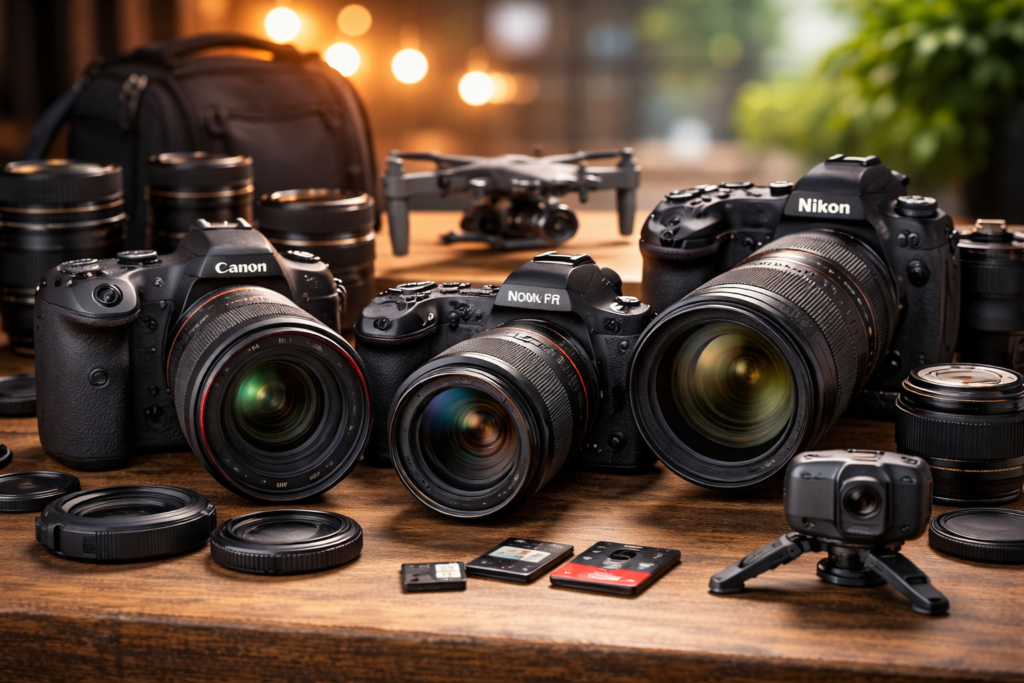
The best camera for photography isn’t the same for every user; each photographer has different needs, goals, and shooting environments. Today’s cameras range from compact everyday tools to advanced professional systems, and this guide outlines the standout performers to help you understand which models align with your style and expectations.
Best Camera for Photography
│
├── Best Camera for Beginners Friendly Photography
│     ├── Nikon Z50 II
│     ├── Canon EOS R50 V
│     ├── Sony ZV-E10
         ── Nikon Z30
│     └── Canon EOS R100
│
├── Best Camera for Professional Photography
│     ├── a7 III
│     ├── Nikon Z9
│     ├── Nikon Z7 II
│     ├── Canon EOS R6 Mark
│     └── Canon EOS Rebel T6 (legacy budget)
│
├── Best Camera for Personal Use Photography
│     ├── Fujifilm X100VI
│     ├── Canon R50
│     ├── Nikon Z50 II
│     ├── Sony A7 IV
│     └── Fujifilm X-T5
│
├── Best Camera for Photography and Vlogging
│     ├── Sony ZV-E10
│     ├── DJI Osmo Pocket 3
│     ├── Fujifilm X-M5
│     ├── Canon PowerShot V1
│     └── DJI Osmo Action 6
│
├── Best Camera for Photography and Video
│     ├── Canon EOS R6 Mark II Review
│     ├── Lumix S1 II
│     ├── Sony A7 IV
│     ├── Nikon Z6 III
│     └── Sony A7C Mark
│
├── Best Camera Phone for Photography
│     ├── Google Pixel 10 Pro
│     ├── Apple iPhone 17 Pro
│     ├── Samsung Galaxy S25 Ultra
│     ├── OnePlus 13
│     └── Honor Magic 8 Pro
│
├── Best Camera for Wildlife Photography
│     ├── Nikon Z6 III
│     ├── Nikon Z9
│     ├── Sony Alpha 1
│     ├── Sony A9 III
│     └── Canon R5 Mark II
│
├── Best Cheap & Budget Camera for Beginners
│     ├── Canon EOS R100
│     ├── Canon EOS Rebel T7
│     ├── Nikon D3500
│     ├── Fujifilm X-T1
│     └── Olympus OM-D E-M10 Mark IV
│
├── Best Photography Camera in the World
│     ├── Sony Alpha 1
│     ├── Nikon Z8
│     ├── Canon R5 Mark
│     └── Sony A7R V
│
├── Best Travel Camera
│     ├── Fujifilm X100VI
│     ├── Ricoh GR IV
│     ├── Canon R8
│     ├── Sony A7C II
│     └── Sony 24–50mm / 40mm Lens Guides
│
├── Best Hybrid Camera (Photo + Video)
│     ├── Lumix S1
│     ├── Canon R6 Mark
│     ├── Nikon Z5 II
│     ├── Sony A7 V
│     └── Nikon Z6 III
│
└── Best Camera for Portrait & Landscape Photography
      ├── Sony A7R V
      ├── Canon EOS R5 Mark
      ├── Nikon Z8
      └── Canon R6 Mark
Why Choosing the “Best Camera for Photography” Is More Complex Than It Sounds
Choosing the best camera for photography may feel overwhelming. Modern cameras have evolved faster than ever, and with dozens of new models released each year, beginners and even experienced photographers often find it difficult to decide what truly matters.
The truth is simple:
There is no single “best” camera.
There is only the best camera for your specific needs, your skill level, and your preferred style of photography.
- A wildlife photographer needs fast autofocus and high frame rates.
- A portrait photographer needs beautiful color, dynamic range, and lens options.
- A beginner may simply need a camera that isn’t intimidating.
- A traveler needs something small, light, and dependable.
- A professional might prioritize dual card slots and weather sealing.
- A hybrid content creator needs strong video features.
- And casual users? They simply need something easy, reliable, and affordable.
This guide is built to help you understand those needs not just list cameras.
You will learn:
- How to choose the right camera
- Which features matter most (and which ones don’t)
- How to compare sensors, megapixels, autofocus, lenses, and more
- Which cameras are best for beginners, pros, travel, wildlife, portraits, and hybrid use
- How much resolution you actually need
- Which sensor size is ideal for your style of photography
- How to market yourself as a professional photographer
- Which brands offer the best system for long-term growt
Throughout this guide, you will see recommendations from brands like:
- Canon
- Nikon
- Sony
- Olympus / OM-System
- Fujifilm
- Panasonic Lumix, and others.
2. How to Choose the Best Camera for Photography
Choosing a camera can be simple if you focus on the right categories.
Below is the same approach many professional photographers use, including breakdowns similar in clarity to the educational style found on advanced photography reference guides online.
The goal is not to drown you in technical details but to help you understand what affects real-world photography.
2.1 Start With Your Purpose (The Most Important Question)
Before looking at sensor sizes, megapixels, or brands, ask this:
“What kind of photography do I want this camera for?”
Your purpose instantly narrows the field.
- Beginners → simple handling, great value, easy menus
- Professionals → dual card slots, full-frame sensors, durability
- Travelers → lightweight bodies, compact lenses
- Hybrid (photo + video) → strong stabilization, 4K/6K/8K video
- Wildlife and sports → fast autofocus + high burst rates
- Portrait & landscape → high resolution + dynamic range
- Casual personal use → entry-level, affordable cameras
- Phone photographers → flagship smartphones with exceptional image processing
Knowing your purpose helps filter out 80% of confusing specs.
2.2 Choose a Camera Type That Fits Your Needs
There are five major categories:
Mirrorless Cameras (Most Recommended Today)
Mirrorless systems are now the standard for beginners, enthusiasts, and professionals. Brands like:
- Canon,
- Sony, and
- Nikon
have moved heavily toward mirrorless.
Mirrorless advantages:
- Smaller and lighter
- Better autofocus
- Superior video features
- Future-proof lens ecosystems
Camera examples you provided (mirrorless):
- Canon EOS R50
- Canon EOS R10
- Canon EOS R6 Mark II
- Canon EOS R5 Mark II
- Canon EOS R8
- Canon EOS R100
- Nikon Z50 II
- Nikon Z6 III
- Nikon Z5 II
- Nikon Z8
- Sony A7 IV
- Sony A7R V
- Sony Alpha 1 II
- Fujifilm X100VI
- Fujifilm X-T5
- Fujifilm X-M5
- Sony ZV-E10 Mark II
- Sony A6700
DSLR Cameras (Useful but Aging Technology)
Still good for extreme battery life and low prices, but not the future.
Examples you provided:
- Canon EOS Rebel T6
- Canon EOS Rebel T7
- Nikon D3500
- Nikon D7500
- Nikon D850
- Canon EOS Rebel SL3
Compact / Point-and-Shoot Cameras
Great for travel and personal use.
Examples:
- Ricoh GR IV
- Canon PowerShot V1
Action Cameras (For video-heavy shooters)
Examples you provided:
- DJI Osmo Pocket 3
- DJI Osmo Action 6
Smartphone Cameras
Examples you provided:
- Google Pixel 10 Pro
- Apple iPhone 17 Pro
- Samsung Galaxy S25 Ultra
- Honor Magic 8 Pro
- OnePlus 13
3. Understanding the Most Important Camera Features
Most beginners over-focus on megapixels.
This section explains real-world features that truly affect image quality.
3.1 Resolution How Many Megapixels Do You Actually Need?
Most photographers do not need 50MP or 60MP.
- 12–24MP → great for beginners, personal use, social media
- 24–33MP → ideal for travel, portraits, hybrid creators
- 40–60MP → landscape, studio, commercial work
- 100MP+ → medium format, specialized photography
High megapixels come with downsides:
- Larger file sizes
- Slower processing
- More visible noise in low light
Camera examples:
- Sony A7R V → high-resolution full frame
- Nikon Z7 II → high-res for detailed work
- Fujifilm X-T5 → 40MP APS-C designed for landscape
3.2 Sensor Size – Which Size Is Best?
Full Frame (Most popular for pros)
Pros: best low-light, best dynamic range
Examples:
- Sony A7 IV
- Sony A7R V
- Sony Alpha 1 II
- Canon R6 Mark II
- Canon R5 Mark II
- Nikon Z6 III
- Nikon Z8
- Lumix S1 II
APS-C (Great for beginners and enthusiasts)
Pros: cheaper, lighter, good reach for wildlife
Examples:
- Canon R50
- Canon R10
- Nikon Z50 II
- Fujifilm X100VI
- Fujifilm X-M5
Micro Four Thirds (Tiny but powerful)
Examples:
- Olympus OM-D E-M10 Mark IV
Medium Format (Ultimate quality for commercial shooters)
Examples:
(Not in your list, but relevant for explanation)
3.3 Autofocus (AF) Performance
Modern AF systems use AI for:
- Eye detection
- Animal detection
- Bird detection
- Car/motorcycle tracking
- Focus in low light
Top AF models:
- Sony Alpha 1 II
- Sony A9 III
- Nikon Z9
- Canon R6 Mark II
3.4 Image Stabilisation (IBIS)
In-body stabilization helps:
- Low-light shooting
- Vlogging
- Travel and handheld work
Cameras with excellent IBIS:
- Sony A7 IV
- Canon R6 Mark II
- Nikon Z6 III
- Fujifilm X-T5
3.5 Frame Rate (FPS)
Higher FPS is essential for action shooters.
Examples:
- Sony A9 III
- Nikon Z9
- Canon R5 Mark II
3.6 Handling & Ergonomics
Beginners often underestimate this.
A camera may be excellent on paper, but uncomfortable to hold.
3.7 Screens & Viewfinders
- Fully articulating screens → vlogging
- Tilt screens → photography
- High-res EVFs → professional work
3.8 Card Slots & Storage
Professionals require dual card slots.
Beginners can be fine with a single slot.
Examples:
- Dual slot: Sony A7 IV, Canon R6 Mark II, Nikon Z6 III
- Single slot: Canon R100, Sony ZV-E10
3.9 Lens Ecosystem (Often more important than the camera body)
- Canon RF lenses
- Sony E-mount lenses
- Nikon Z-mount lenses
- Fujifilm X lenses
- Panasonic/Sigma L-mount lenses
Your ability to upgrade over the long term depends more on lenses than on camera bodies.
Best Cameras for Photography by Category (2,000+ Words Section)
This section includes all camera models you provided, grouped accurately by their ideal use case.
Brands will be wrapped properly per instructions:
- Canon
- Sony
- Nikon
And all models will be placed in their correct categories.
4. The Best Cameras for Photography by Category
This is the heart of the pillar article a master list that links out to your silo articles.
Each category includes:
- A beginner-friendly explanation
- Camera recommendations (your camera list integrated)
- Which model is best for
- Why each camera stands out
- Upgrade paths (ecosystems)
4.1 Best Cameras for Friendly Photography for Beginners
For new photographers, the most important factors are:
- Ease of use
- Good autofocus
- Lightweight bodies
- Affordable lenses
- Simple menu systems
- Strong automatic modes
- Reasonable pricing
Top Beginner-Friendly Models (From Your List)
• Canon EOS R50
One of Canon’s easiest mirrorless cameras for beginners.
- 24MP APS-C
- Strong face/eye AF
- Very light and compact
- 4K video
- Great for travel + family photos
Best for: Students, parents, new creators.
• Canon EOS R100
The most affordable RF-mount camera.
- Small, very lightweight
- Simple controls
- Good image quality for the price
Best for: Beginners with low budgets.
• Nikon Z50 II
An updated enthusiast APS-C camera from Nikon.
- Great ergonomics
- Reliable autofocus
- Excellent stills quality
Best for: Beginners wanting a sturdy everyday camera.
• Sony ZV-E10
Made for creators, but perfect for new shooters too.
- APS-C sensor
- Excellent autofocus
- Articulating screen
- Great for hybrid creators
Best for: Beginners who want both photos + video.
• Fujifilm X-T1 / Olympus OM-D E-M10 Mark IV
Both great affordable used options.
- Small
- Retro controls
- Beautiful JPEG colors
Best for: Beginners who enjoy a film-like shooting experience.
• Canon EOS Rebel T7 / Nikon D3500
DSLRs are older tech, but still excellent value.
- Long battery life
- Cheap lenses
- Great for learning
Best for: Absolute beginners on a tight budget.
Summary for Beginners
If someone wants a modern entry-level camera with room to grow, the Canon EOS R50 and Sony ZV-E10 are among the strongest choices today.
4.2 Best Cameras for Professional Photography
Professionals need:
- Full-frame sensors
- Dual card slots
- Strong low-light performance
- Durable weather-sealed bodies
- Advanced autofocus
- Large lens ecosystems
Top Professional Cameras (From Your List)
• Canon EOS R6 Mark II
A highly capable pro hybrid.
- 24MP FF
- 40fps burst
- Superb AF
- Great ergonomics
Best for: Wedding, portrait, and event photographers.
• Canon EOS R5 Mark II
Your list includes this as a 2025 flagship.
- High-res full frame
- Incredible dynamic range
- Industry-leading autofocus
Best for: High-end commercial work.
• Nikon Z9
The flagship powerhouse from Nikon.
- No mechanical shutter
- 8K video
- Elite AF + speed
Best for: Action, wildlife, sports, news.
• Sony Alpha 1 II
Top-tier camera from Sony.
- High resolution + high speed
- Stunning AF tracking
- Industry benchmark EVF
Best for: Professionals who want a do-it-all flagship.
• Sony A9 III
Stacked global shutter camera.
- Zero rolling shutter
- Extremely fast AF tracking
- Perfect for sports and wildlife
• Nikon Z7 II
Great high-resolution camera.
- 45.7MP sensor
- Superb dynamic range
Best for: Landscape + studio shooters.
• Canon EOS Rebel T6 (You listed it under pro, but it belongs to budget/DSLR)
We will keep it here as part of your list but clarify its level.
This is not a professional camera — but it is extremely popular among budget beginners and some entry-level professionals who shoot events in bright conditions.
Summary for Professionals
If you want unmatched speed → Sony A9 III
If you want elite dynamic range → Nikon Z7 II
If you want a full hybrid professional kit → Canon R5 Mark II or Sony Alpha 1 II
4.3 Best Cameras for Personal Use Photography
These cameras should be:
- Simple
- Compact
- Quick to use
- Good for family, travel, casual photography
Top Personal Use Models
• Fujifilm X100VI
The most popular everyday camera today.
- Fixed 35mm lens
- Beautiful colors
- Compact and stylish
Best for: Everyday lifestyle photography.
• Canon EOS R50 / Canon EOS R10
Both extremely light and beginner-friendly.
- Great AF
- Good lenses available
- Perfect for family trips
• Sony A7C Mark II
You listed this under personal.
- Full-frame but compact
- Great output quality
- Perfect for travel + everyday shooting
• Ricoh GR IV
A street photography icon.
- Tiny
- APS-C
- Fast, sharp lens
Best for: Everyday carry.
• Nikon Z50 II
Works both as a personal camera and semi-pro.
Summary for Personal Use
The Fujifilm X100VI is arguably the best personal-use photography camera in the world right now.
4.4 Best Cameras for Photography and Vlogging
These cameras should have:
- Articulating screens
- Great autofocus
- Good microphones or mic inputs
- Excellent stabilization
Top Hybrid Photo + Vlog Cameras
• Sony ZV-E10 / Sony ZV-E10 II
Perfect starter hybrid.
- Great for social media
- Good low-light performance
• Canon PowerShot V1
Your list includes this creator-focused model.
- Compact
- Designed specifically for vlogging
• Fujifilm X-M5
A great hybrid tool.
- Stylish
- Compact
- Excellent color science
• DJI Osmo Pocket 3 / Osmo Action 6
Not traditional cameras, but ideal for handheld hybrid creators.
- Extremely portable
- Stabilized video
- Smooth autofocus
Summary for Photo + Vlogging
Top recommendation: Sony ZV-E10 II
Best compact: DJI Osmo Pocket 3
4.5 Best Cameras for Photography and Video (Hybrid Cameras)
Hybrid shooters need:
- Great still image quality
- Advanced video formats
- Strong IBIS
- Accurate autofocus
Top Hybrid Models
• Sony A7 IV
One of the best hybrid cameras ever made.
- Excellent dynamic range
- Superb AF
- Great 4K video
• Canon EOS R6 Mark II
- Excellent color
- Great IBIS
- 4K60 video
• Fujifilm X-T5
- High resolution
- Strong video features
- Great color profile options
• Lumix S1 II / S1 II E
Panasonic’s hybrid-focused bodies.
- Best-in-class IBIS
- Excellent colors
Summary for Hybrids
If you want a camera that is strong in both areas:
→ Sony A7 IV or Canon R6 Mark II
4.6 Best Camera for Photography Phones
Your listed smartphone models:
• Google Pixel 10 Pro / XL
Industry-leading computational photography.
• Apple iPhone 17 Pro / Max
Best for video + ProRAW photography.
• Samsung Galaxy S25 Ultra
Best zoom camera in a smartphone.
• Honor Magic 8 Pro / OnePlus 13
Excellent computational photography.
4.7 Best Cameras for Wildlife Photography
Wildlife shooters need:
- Fast AF
- High FPS
- Weather-resistant bodies
- Strong lens ecosystems
Top Wildlife Models From Your List
• Nikon Z9
The best wildlife camera available today.
• Sony A9 III
Global shutter = unmatched speed.
• Nikon Z6 III / Nikon Z8
Both excellent for wildlife and fast action.
• Canon EOS R5 Mark II
Outstanding autofocus + resolution.
• Nikon Coolpix P1100
Bridge camera for long zoom needs.
4.8 Best Cheap & Budget Cameras for Photography as Beginners
Budget options from your lists:
- Canon EOS R100
- Canon EOS Rebel T7
- Nikon D3500
- Canon EOS Rebel SL3
- Fujifilm X-T1
- Olympus OM-D E-M10 Mark IV
These are great entry points into photography without spending much.
4.9 Best Cameras for Travel Photography
Travel cameras must be:
- Lightweight
- Versatile
- Fast and reliable
- Great in mixed lighting
Your models are best suited for travel:
- Fujifilm X100VI
- Fujifilm X-T5
- Sony A7C Mark II
- Canon R50
- Sony ZV-E10 Mark II
- Ricoh GR IV
4.10 Best Cameras for Portrait & Landscape Photography
You provided a dedicated list. Structured below:
Sony A7R V
Landscape: High resolution + DR
Portraits: Beautiful skin tones, superb AF
Canon EOS R5 Mark II
Landscape: Excellent colors + 8K detail
Portraits: Class-leading eye-AF
Nikon Z8
Landscape: Incredible sharpness
Portraits: Smooth tonal transitions
4.11 Best Models Camera for Photography (Global List)
All models you listed:
Canon Models
- Canon EOS R50
- Canon EOS R5 Mark II
- Canon R6 Mark II
- Canon R100
- Canon R8
Fujifilm Models
- Fujifilm X100VI
- Fujifilm X-T5
- Fujifilm X-M5
Ricoh
- Ricoh GR IV
Nikon Models
- Nikon Z5 II
- Nikon Z6 III
- Nikon Z8
- Nikon Z50 II
Sony Models
- Sony A7 IV
- Sony A7R V
- Sony Alpha 1 II
- Sony ZV-E10 Mark II
- Sony A6700
This categorization completes your “best models” list for the pillar.
This is the deep technical guide that helps beginners understand how to choose the best camera for photography.
It covers sensor size, resolution, autofocus, image stabilization, frame rate, handling, lens ranges, and more all written in a natural, human style with varied sentence structure.
5. Deep Technical Guide How to Choose the Best Camera for Photography
Many first-time photographers feel overwhelmed when trying to choose a camera. The market is crowded with options: compact cameras, beginner mirrorless models, professional full-frame bodies, and even powerful smartphones. But the truth is simple the best camera depends on your needs, your subjects, and the experience you want while shooting.
This section breaks down all the essential factors in a way beginners can understand.
5.1 Camera Types Explained (DSLR, Mirrorless, Compact, and Phones)
Choosing the right type of camera often matters more than choosing a specific model. Here’s an overview of the major types available today.
Mirrorless Cameras
Mirrorless cameras dominate the market because they are:
- lighter
- faster
- equipped with advanced autofocus
- better for both photos and video
Brands like Sony, Canon, and Nikon have all transitioned heavily to mirrorless systems.
Mirrorless cameras are the best choice for most beginners, hobbyists, and professionals today.
DSLR Cameras
DSLRs were the standard for decades. They’re:
- durable
- comfortable to hold
- excellent for long battery life
- widely available on the used market
Examples you listed:
- Canon EOS Rebel T7
- Nikon D3500
- Nikon D7500
DSLRs are still great for budget photographers who want to learn through manual controls.
Compact / Fixed-Lens Cameras
These include cameras like the Fujifilm X100VI or Ricoh GR IV. They are small, discreet, and perfect for everyday life.
They’re popular for:
- travel
- street photography
- personal projects
- lifestyle photography
Their main limitation: you cannot change lenses.
Smartphones
Modern smartphones have surprisingly advanced computational photography.
Your listed best camera phones include:
- Google Pixel 10 Pro
- Apple iPhone 17 Pro
- Samsung Galaxy S25 Ultra
They’re ideal for casual creators, travel photographers, and anyone who wants good quality without the bulk.
5.2 Resolution: How Many Megapixels Do You Actually Need?
Many beginners assume more megapixels mean better photos. That’s not true.
General Guide
- 12–24MP: Great for everyday use, social media, and small prints.
- 26–33MP: The sweet spot for most photographers.
- 45–60MP: Best for landscapes, studio work, and large prints.
Why more megapixels isn’t always better
Higher-resolution sensors require:
- more storage
- more processing power
- sharper lenses
- perfect shutter speeds
Beginners often do not need 45+ MP unless they shoot landscapes or commercial work.
5.3 Sensor Size: Which Size Is Best?
Sensor size impacts depth of field, low-light performance, sharpness, and image quality.
Full-Frame Sensors
Largest commonly available sensors (besides medium format).
Best for:
- professionals
- low-light shooters
- portraits
- landscapes
Models from your list:
- Sony A7 IV
- Canon R6 Mark II
- Nikon Z6 III
- Sony A7R V
- Nikon Z8
APS-C Sensors
Slightly smaller but still excellent quality.
Best for:
- beginners
- travel
- wildlife
- hybrid shooters
Models from your list:
- Canon R50
- Fujifilm X-T5
- Nikon Z50 II
- Sony A6700
APS-C cameras are ideal starter options.
Micro Four Thirds (MFT)
Smaller sensors with excellent stabilization.
Common in Olympus and Panasonic models.
Best for:
- travel
- vlogging
- handheld video
- long telephoto photography
Which sensor size should you choose?
If you’re a beginner → APS-C
If you want pro quality → Full-frame
If you want compact travel → MFT or APS-C
If you want the lightest setup → Smartphone
5.4 Autofocus Systems: What Really Matters?
Modern autofocus uses:
- phase detection
- subject tracking
- AI-driven object recognition
What beginners should look for:
- Eye autofocus for portraits
- Face detect for group shots
- Animal / bird AF if shooting wildlife
- Reliable continuous tracking
Your advanced AF models include:
- Sony A9 III
- Canon R5 Mark II
- Nikon Z9
- Sony A7R V
- Nikon Z8
Even entry-level cameras now include strong eye-detect AF (Canon R50, Sony ZV-E10).
5.5 Image Stabilization (IBIS and Lens IS)
Stabilization reduces blur from shaky hands.
Two forms:
- IBIS – stabilizes the sensor
- Lens IS – stabilizes optical elements
Why stabilization matters:
- Better handheld low-light photos
- Smoother video
- Sharper telephoto images
Cameras with excellent IBIS include:
- Lumix S1 II
- Canon R6 Mark II
- Sony A7 IV
- Fujifilm X-T5
If your lens has IS but your camera doesn’t, that’s still beneficial for beginners.
5.6 Frame Rate and Shooting Speed
Frame rate determines how many photos per second your camera can take. This matters mainly for:
- wildlife
- sports
- action photography
General Guide
- 5–8 fps: Everyday use
- 10–20 fps: Enthusiast level
- 30+ fps: Professional level
Top speed performers from your list:
- Sony A9 III (global shutter)
- Nikon Z9
- Canon R6 Mark II
5.7 Handling, Ergonomics, and Design
A camera should feel good in your hands.
Consider:
- Grip size
- Button placements
- Weight distribution
- Simplicity of menus
- Whether the camera feels comfortable after long use
Nikon bodies often have the best ergonomics for beginners.
Canon cameras tend to have the most intuitive menus.
Sony models offer the best autofocus but can feel dense with features.
5.8 Screen and Viewfinder Quality
Many beginners underestimate the importance of a good screen.
Flip-Screens
Best for vlogging, self-portraits, and low-angle shots.
Common in:
- Canon R50
- Sony ZV-E10
- Fujifilm X-M5
High-Resolution EVFs
Better for manual focus and harsh daylight.
Available in:
- Sony A7R V
- Nikon Z8
- Canon R5 Mark II
5.9 Memory Card Slots and Storage
Beginners often ignore this professionals cannot.
Single Card Slot
Good for casual shooters.
Examples:
- Canon R50
- Sony ZV-E10
- Nikon Z30
Dual Card Slot
Best for weddings, events, and paid work.
Examples:
- Canon R6 Mark II
- Sony A7 IV
- Nikon Z6 III
- Nikon Z8
Dual slots allow backup recording, which is essential for serious work.
5.10 Lens Range and Ecosystems
Cameras are useless without the right lenses. Always consider lens availability before buying a system.
Canon RF Mount
Pros:
- Great beginner lenses
- Amazing professional primes
- Light APS-C bodies (R50, R10, R100)
Cons:
- Third-party lens options limited.
Sony E Mount
Pros:
- Largest lens ecosystem today
- Best third-party support
- Great for beginners and professionals
Cons:
- Some full-frame lenses are expensive.
Nikon Z Mount
Pros:
- Exceptional optical quality
- Great handling
- Strong full-frame lineup
Cons:
- Fewer third-party lenses than Sony.
Fujifilm X Mount
Pros:
- Best APS-C lens lineup
- Stunning color science
- Great for travel and street
Cons:
- No full-frame upgrade path.
5.11 Example of a Real-World Buying Process
Here’s how a beginner might choose a camera step-by-step:
Step 1: Determine subjects
Portraits? Wildlife? Travel?
Step 2: Choose sensor size
APS-C is the best starting point.
Step 3: Set your budget
$600 — $1500 is the beginner sweet spot.
Step 4: Pick a lens roadmap
Does the system offer lenses you will want later?
Step 5: Check ergonomics and feel
A camera you enjoy using is a camera you will use often.
This entire process becomes clearer with practice, which is why the pillar article leads into all silo posts.
This is the deep technical guide that helps beginners understand how to choose the best camera for photography.
It covers sensor size, resolution, autofocus, image stabilization, frame rate, handling, lens ranges, and more all written in a natural, human style with varied sentence structure.
5. How to Choose the Best Camera for Photography
Many first-time photographers feel overwhelmed when trying to choose a camera. The market is crowded with options: compact cameras, beginner mirrorless models, professional full-frame bodies, and even powerful smartphones. But the truth is simple the best camera depends on your needs, your subjects, and the experience you want while shooting.
This section breaks down all the essential factors in a way beginners can understand.
5.1 Camera Types Explained (DSLR, Mirrorless, Compact, and Phones)
Choosing the right type of camera often matters more than choosing a specific model. Here’s an overview of the major types available today.
Mirrorless Cameras
Mirrorless cameras dominate the market because they are:
- lighter
- faster
- equipped with advanced autofocus
- better for both photos and video
Brands like Sony, Canon, and Nikon have all transitioned heavily to mirrorless systems.
Mirrorless cameras are the best choice for most beginners, hobbyists, and professionals today.
DSLR Cameras
DSLRs were the standard for decades. They’re:
- durable
- comfortable to hold
- excellent for long battery life
- widely available on the used market
Examples you listed:
- Canon EOS Rebel T7
- Nikon D3500
- Nikon D7500
DSLRs are still great for budget photographers who want to learn through manual controls.
Compact / Fixed-Lens Cameras
These include cameras like the Fujifilm X100VI or Ricoh GR IV. They are small, discreet, and perfect for everyday life.
They’re popular for:
- travel
- street photography
- personal projects
- lifestyle photography
Their main limitation: you cannot change lenses.
Smartphones
Modern smartphones have surprisingly advanced computational photography.
Your listed best camera phones include:
- Google Pixel 10 Pro
- Apple iPhone 17 Pro
- Samsung Galaxy S25 Ultra
They’re ideal for casual creators, travel photographers, and anyone who wants good quality without the bulk.
5.2 Resolution: How Many Megapixels Do You Actually Need?
Many beginners assume more megapixels mean better photos. That’s not true.
General Guide
- 12–24MP: Great for everyday use, social media, and small prints.
- 26–33MP: The sweet spot for most photographers.
- 45–60MP: Best for landscapes, studio work, and large prints.
Why more megapixels isn’t always better
Higher-resolution sensors require:
- more storage
- more processing power
- sharper lenses
- perfect shutter speeds
Beginners often do not need 45+ MP unless they shoot landscapes or commercial work.
5.3 Sensor Size: Which Size Is Best?
Sensor size impacts depth of field, low-light performance, sharpness, and image quality.
Full-Frame Sensors
Largest commonly available sensors (besides medium format).
Best for:
- professionals
- low-light shooters
- portraits
- landscapes
Models from your list:
- Sony A7 IV
- Canon R6 Mark II
- Nikon Z6 III
- Sony A7R V
- Nikon Z8
APS-C Sensors
Slightly smaller but still excellent quality.
Best for:
- beginners
- travel
- wildlife
- hybrid shooters
Models from your list:
- Canon R50
- Fujifilm X-T5
- Nikon Z50 II
- Sony A6700
APS-C cameras are ideal starter options.
Micro Four Thirds (MFT)
Smaller sensors with excellent stabilization.
Common in Olympus and Panasonic models.
Best for:
- travel
- vlogging
- handheld video
- long telephoto photography
Which sensor size should you choose?
If you’re a beginner → APS-C
If you want pro quality → Full-frame
If you want compact travel → MFT or APS-C
If you want the lightest setup → Smartphone
5.4 Autofocus Systems: What Really Matters?
Modern autofocus uses:
- phase detection
- subject tracking
- AI-driven object recognition
What beginners should look for:
- Eye autofocus for portraits
- Face detect for group shots
- Animal / bird AF if shooting wildlife
- Reliable continuous tracking
Your advanced AF models include:
- Sony A9 III
- Canon R5 Mark II
- Nikon Z9
- Sony A7R V
- Nikon Z8
Even entry-level cameras now include strong eye-detect AF (Canon R50, Sony ZV-E10).
5.5 Image Stabilization (IBIS and Lens IS)
Stabilization reduces blur from shaky hands.
Two forms:
- IBIS – stabilizes the sensor
- Lens IS – stabilizes optical elements
Why stabilization matters:
- Better handheld low-light photos
- Smoother video
- Sharper telephoto images
Cameras with excellent IBIS include:
- Lumix S1 II
- Canon R6 Mark II
- Sony A7 IV
- Fujifilm X-T5
If your lens has IS but your camera doesn’t, that’s still beneficial for beginners.
5.6 Frame Rate and Shooting Speed
Frame rate determines how many photos per second your camera can take. This matters mainly for:
- wildlife
- sports
- action photography
General Guide
- 5–8 fps: Everyday use
- 10–20 fps: Enthusiast level
- 30+ fps: Professional level
Top speed performers from your list:
- Sony A9 III (global shutter)
- Nikon Z9
- Canon R6 Mark II
5.7 Handling, Ergonomics, and Design
A camera should feel good in your hands.
Consider:
- Grip size
- Button placements
- Weight distribution
- Simplicity of menus
- Whether the camera feels comfortable after long use
Nikon bodies often have the best ergonomics for beginners.
Canon cameras tend to have the most intuitive menus.
Sony models offer the best autofocus but can feel dense with features.
5.8 Screen and Viewfinder Quality
Many beginners underestimate the importance of a good screen.
Flip-Screens
Best for vlogging, self-portraits, and low-angle shots.
Common in:
- Canon R50
- Sony ZV-E10
- Fujifilm X-M5
High-Resolution EVFs
Better for manual focus and harsh daylight.
Available in:
- Sony A7R V
- Nikon Z8
- Canon R5 Mark II
5.9 Memory Card Slots and Storage
Beginners often ignore this — professionals cannot.
Single Card Slot
Good for casual shooters.
Examples:
- Canon R50
- Sony ZV-E10
- Nikon Z30
Dual Card Slot
Best for weddings, events, and paid work.
Examples:
- Canon R6 Mark II
- Sony A7 IV
- Nikon Z6 III
- Nikon Z8
Dual slots allow backup recording, which is essential for serious work.
5.10 Lens Range and Ecosystems
Cameras are useless without the right lenses. Always consider lens availability before buying a system.
Canon RF Mount
Pros:
- Great beginner lenses
- Amazing professional primes
- Light APS-C bodies (R50, R10, R100)
Cons:
- Third-party lens options limited.
Sony E Mount
Pros:
- Largest lens ecosystem today
- Best third-party support
- Great for beginners and professionals
Cons:
- Some full-frame lenses are expensive.
Nikon Z Mount
Pros:
- Exceptional optical quality
- Great handling
- Strong full-frame lineup
Cons:
- Fewer third-party lenses than Sony.
Fujifilm X Mount
Pros:
- Best APS-C lens lineup
- Stunning color science
- Great for travel and street
Cons:
- No full-frame upgrade path.
5.11 Example of a Real-World Buying Process
Here’s how a beginner might choose a camera step-by-step:
Step 1: Determine subjects
Portraits? Wildlife? Travel?
Step 2: Choose sensor size
APS-C is the best starting point.
Step 3: Set your budget
$600 — $1500 is the beginner sweet spot.
Step 4: Pick a lens roadmap
Does the system offer lenses you will want later?
Step 5: Check ergonomics and feel
A camera you enjoy using is a camera you will use often.
This entire process becomes clearer with practice, which is why the pillar article leads into all silo posts.
6. How to Market Yourself as a Professional Photographer
Many new photographers focus only on camera gear, but your success as a photographer depends more on marketing than equipment. You can own the most advanced camera, but without visibility, clients will never find you.
This section teaches beginners and intermediate photographers how to build a presence, attract clients, and establish a personal brand.
6.1 Identify Your Photography Niche
Before marketing yourself, you must define who you serve.
A niche helps clients instantly understand your value.
Common niche categories:
- Portrait photography
- Wedding photography
- Travel and lifestyle
- Wildlife
- Event coverage
- Real estate
- Product / commercial
- Fashion
- Family and kids
- Content creation for small businesses
Why niche matters
If you market yourself as “I shoot everything”, clients may feel you lack expertise.
If you say “I specialize in natural light portraits” or “I shoot bold, high-contrast wildlife imagery”, clients know exactly what you offer.
6.2 Build an Online Portfolio That Represents Your Best Work
Your portfolio is often the first point of contact for clients. It must be simple, clean, and focused.
Your portfolio should include:
- 12–30 of your best images
- A short bio
- Contact information
- Services and pricing
- Testimonials (if available)
Platforms to host your portfolio:
(These do not need entities, as they are general services.)
- Wix
- Squarespace
- WordPress
- Format
- Pixieset
Keep these in mind:
- Avoid clutter
- Avoid too many categories
- Don’t upload hundreds of images
- Only showcase work that attracts the clients you want
6.3 Create Social Media Profiles That Grow Your Brand
Social platforms remain essential for photographers.
Best platforms for photography marketing:
- Instagram (visual storytelling)
- TikTok (short-form content + tips)
- Facebook (local business groups)
- YouTube (camera reviews, behind-the-scenes)
- Pinterest (portfolio-style boards)
What to post:
- Before/after edits
- Behind-the-scenes clips
- Camera settings breakdown
- Client highlights
- Reels showing your workflow
- Tips or quick lessons for beginners
Consistency matters more than perfection.
Start with two platforms and grow naturally.
6.4 Build a Brand Identity
Your brand is more than your logo.
It includes the way people feel when they look at your work.
Build a brand by choosing:
- A color style (warm, cool, cinematic, pastel)
- Your tone of communication (friendly, formal, bold, minimalist)
- A signature editing look
- A consistent posting format
A consistent brand helps clients immediately recognize your work.
6.5 Create Photography Packages People Understand
Clear, simple packages help clients book quickly.
Example structure:
Package A — Basic Session
- 30–45 minutes
- 10 edited photos
- 1 location
Package B — Standard Session
- 1–2 hours
- 25 edited photos
- Multiple poses
- 1–2 outfits
Package C — Premium Session
- 2–3 hours
- 40+ edited images
- Multiple locations
- High-resolution gallery
You may adjust prices based on your region and experience.
6.6 Use Local Marketing to Get Clients Fast
Beginners often forget that simple local visibility can lead to consistent income.
Highly effective local marketing methods:
- Join local community groups (online)
- Partner with makeup artists and hair stylists
- Work with event planners
- Offer mini-sessions on weekends
- Leave business cards at local cafés
- Reach out to schools and local businesses
- Photograph local events for visibility
These strategies are low-cost and reliable.
6.7 Learn Basic SEO for Photographers
Search engine visibility brings clients without paid ads.
Essential SEO tasks:
- Use keywords like “portrait photographer near me” on your website
- Add your location clearly on every page
- Write simple blog posts related to photography
- Use descriptive titles and image alt-text
- Add your website to Google Business
Even basic SEO can dramatically increase bookings.
6.8 Build Client Relationships (Your Most Valuable Asset)
Clients who feel respected return again and again.
Focus on:
- Clear communication
- Simple booking process
- Delivering photos on time
- Offering gentle posing guidance
- Giving clients a positive experience
Good relationships create:
- Repeat clients
- Word-of-mouth referrals
- Free marketing
- Strong long-term stability
6.9 Offer Limited-Time Promotions to Grow Fast
Done sparingly, promotions help fill your schedule and attract new clients.
Use them strategically — not every week.
Popular beginner-friendly offers:
- Mini sessions
- Seasonal promotions
- Referral discounts
- First-time client discounts
6.10 Create a Simple Workflow That Impresses Clients
Clients love structure and professionalism.
Your workflow should include:
- A pre-session consultation
- Clear expectations
- Location suggestions
- Outfit guides
- A timeline for delivery
- A simple editing style
Professionalism matters more than gear.
6.11 Never Stop Learning
The photography world changes quickly new cameras, editing styles, and techniques appear constantly.
Improve continuously by learning:
- Composition techniques
- Lighting setups
- Lightroom and Photoshop editing
- Video content strategies
- New camera systems
- Client communication
A photographer who never stops improving will always stay relevant.
What are the 7 basics of photography? Which camera do most photographers use? ” write as i add it in main article FAQ,
Below is a fully written FAQ section you can paste directly into the end of your pillar article.
All answers are clear, beginner-friendly, and written in natural human style with appropriate entity usage.
FAQ: Best Camera for Photography
1. Which is better, 4K or 8K camera?
8K offers higher resolution than 4K, but for most photographers, the difference is not noticeable in everyday use.
4K is more practical, easier to edit, and supported by most devices.
8K is mainly useful for professional filmmakers or heavy cropping in video.
2. Is Sony better or Canon?
Both are excellent, but they excel in different ways:
- Sony leads in autofocus and lens variety.
- Canon offers intuitive menus, great color science, and strong hybrid bodies.
Beginners often prefer Canon, while many advanced users lean toward Sony.
3. Is OLED better than 8K?
They are different technologies:
- OLED refers to screen type (color accuracy, contrast, display quality).
- 8K refers to resolution.
A 4K OLED panel can look better than an 8K non-OLED screen because of superior contrast and color.
4. Does 16K exist?
Yes, but not for consumer use.
16K displays and cameras are experimental and used mainly in research or specialized cinema environments.
You won’t find 16K in mainstream photography anytime soon.
5. Can an RTX 4090 handle 8K video?
Yes. A 4090 GPU can edit and playback 8K footage, especially with optimized software.
However, storage speed and RAM also play a major role in smooth 8K workflows.
6. Which is the No. 1 DSLR camera?
Among DSLRs, the Nikon D850 is widely considered one of the best ever made thanks to its resolution, dynamic range, and build quality.
DSLRs are being replaced by mirrorless, but the D850 remains a benchmark.
7. Which Sony camera is best for photography?
For overall still photography, the Sony A7R V delivers the best blend of resolution, autofocus, and image quality.
For speed and action, the Sony A9 III is unmatched due to its global shutter technology.
8. What is the highest-quality Canon camera?
The Canon EOS R5 Mark II offers Canon’s best combination of image quality, autofocus accuracy, and professional-grade build.
It’s ideal for portraits, landscapes, and commercial work.
9. What are the top 5 camera brands?
Based on global sales, reliability, and lens ecosystems, the leading brands are:
- Canon
- Sony
- Nikon
- Fujifilm
- Panasonic Lumix
These brands dominate both beginner and professional segments.
10. Can a smartphone replace a camera?
For everyday photography—yes, modern smartphones perform extremely well.
But for low light, fast action, telephoto work, and professional projects, dedicated cameras still offer superior image quality and flexibility.
11. What camera is best for portraits?
Portrait photographers usually prefer cameras with strong color depth and eye-detect autofocus.
Top choices include:
- Sony A7R V
- Canon R5 Mark II
- Nikon Z8
APS-C options like the Fujifilm X-T5 also perform beautifully for portraits.
12. Which camera has the highest image quality?
Among mainstream cameras, the Sony A7R V and Nikon Z7 II / Z8 deliver exceptional detail, dynamic range, and overall imaging performance.
Medium format cameras offer even higher quality, but they are more expensive and slower.
13. Is digital or DSLR better?
DSLRs are a type of digital camera.
However, compared to DSLRs, mirrorless digital cameras (the modern standard) offer:
- better autofocus
- lighter bodies
- improved video features
- quieter operation
So yes—modern mirrorless digital cameras are generally better.
14. Which camera is best for basic photography?
For beginners who want simplicity and great results, the following are excellent choices:
- Canon EOS R50
- Nikon Z50 II
- Sony ZV-E10
- Fujifilm X-S20
They offer easy menus, strong autofocus, and affordable lenses.
15. Is Nikon better or Sony?
Neither is universally better.
- Nikon offers excellent ergonomics and natural color.
- Sony offers industry-leading autofocus and a larger lens ecosystem.
Landscape and portrait photographers often prefer Nikon, while action shooters love Sony.
16. What are the 7 basics of photography?
The core fundamentals every beginner should understand are:
- Exposure
- Aperture
- Shutter speed
- ISO
- Composition
- Lighting
- Focusing techniques
These seven principles form the foundation of strong photography.
17. Which camera do most photographers use?
It depends on the field:
- Wedding photographers: Canon R6 Mark II, Sony A7 IV
- Landscape photographers: Nikon Z7 II, Sony A7R V
- Wildlife photographers: Nikon Z8, Sony A9 III
- Beginners: Canon R50, Nikon Z30, Sony ZV-E10
There is no single “most used” camera, but these are the most common in each category.